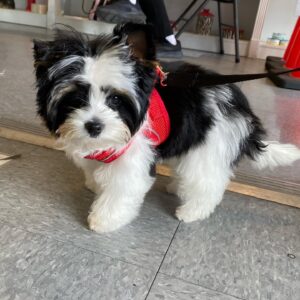

Who Is Archie, Really?
There are dogs that fill a room with noise. Then there is Archie — a Scottish Terrier who fills it with presence. Compact, wiry-coated, and possessed of a personality far larger than his sturdy little frame, Archie represents everything that makes the Scottish Terrier one of the most distinctive and celebrated breeds in the world.
When you first meet Archie, what strikes you isn’t just the beard — magnificent as it is — or the erect ears that seem to be permanently tuned to frequencies only Scotties can detect. It’s the look in his eyes. Bright, curious, and utterly self-assured. Archie does not seek your approval. He simply assumes you’ll be delighted to know him. (You will be.)
“Archie woke up that first morning in our home, stretched exactly once, surveyed the room like a laird surveying his estate, and then sat down for breakfast as if he’d always lived there. He had. He just hadn’t arrived yet.”
Responsible Scottish Terrier breeders understand that this temperament — proud, spirited, deeply loyal — doesn’t happen by accident. It is bred with intention, nurtured with care, and shaped over generations of thoughtful pairing. Archie is proof of what happens when breeding is done right.
The Archie Paradox
Ask anyone who has shared their life with a Scottie and they’ll describe the same paradox: this is a dog who is simultaneously stubborn and devoted, independent and velcro-like, dignified and utterly ridiculous when a tennis ball appears. Archie contains multitudes.
He is not a golden retriever. He will not fetch endlessly or greet every stranger like a long-lost best friend. But for his people — his people — there is no more steadfast companion in the canine kingdom.
Chapter Two
The Breed Behind the Dog: Scottish Terrier Breeders and Their Legacy
To understand Archie, you need to understand where he comes from. The Scottish Terrier — affectionately nicknamed “the Diehard” — is one of five terrier breeds native to Scotland, with roots stretching back to the rugged terrain of the Scottish Highlands. Bred to hunt fox, badger, and vermin in rocky, unforgiving landscapes, Scotties developed their trademark tenacity out of pure necessity.
Today’s Scottish Terrier breeders are the custodians of this heritage. The best among them don’t simply produce puppies — they steward a living history, carefully maintaining the breed’s physical structure, instinctual drive, and the distinctive character that has made Scotties beloved by royals, presidents, and ordinary families alike.
What Makes a Reputable Scottish Terrier Breeder?
Not every person selling Scottie puppies is a Scottish Terrier breeder in the truest sense. A genuine, reputable breeder is one who:
— Health-tests their breeding stock for conditions common in the breed, including Scottie cramp, von Willebrand’s disease, and certain cancers that the breed is statistically prone to.
— Socializes litters from the earliest weeks, ensuring puppies like Archie arrive in their new homes already comfortable with the sounds, smells, and chaos of human life.
— Maintains deep knowledge of their bloodlines and breeds with temperament and health as the primary goals — not coat color or “rare” traits that attract premium prices without genetic merit.
— Is registered with the Scottish Terrier Club of America (STCA) or equivalent national breed club and welcomes questions, home checks, and ongoing communication with puppy buyers.
When Archie came home, his breeder had already imprinted the world on him. He wasn’t afraid of the vacuum cleaner, the children next door, or the cat who thought the house was hers. That groundwork — invisible but irreplaceable — is the breeder’s real gift.
Chapter Three
Life With Archie: A Day in the Scottie Household
6:47 a.m. Archie does not wait for alarms. He has, presumably, already evaluated the weather, assessed the threat level of the neighbor’s cat from the bedroom window, and determined that breakfast is seventeen minutes overdue. You are informed of this through a series of escalating signals that begin with staring and end with a single, sharp, imperial bark.
Morning walks with Archie are investigative expeditions. Every patch of grass is a crime scene. Every lamp post, a bulletin board of neighborhood news. He walks with his nose millimeters from the pavement, his stumpy legs moving at a purposeful trot, his beard picking up approximately 40% of the local plant life.
The Training Reality
Here is what Scottish Terrier breeders will tell you — honestly, if they’re the right kind of breeder — before you bring home your Scottie: this breed is not built for blind obedience. They were bred to work independently, to make decisions underground where no human hand could guide them. That instinct doesn’t disappear in a suburban home.
Archie has mastered sit, stay, and come. He performs them willingly when the situation merits it — which is to say, when there is a treat involved and he is in the mood. Training a Scottie requires consistency, positive reinforcement, a sense of humor, and the profound humility of accepting that you are, at best, a co-equal partner in this relationship.
The Loyalty No One Warns You About
What the breed books mention and daily life confirms: Scotties are devoted in a way that is quiet, consistent, and occasionally overwhelming. Archie does not perform affection. He simply appears wherever you are. Working from home? Archie is under the desk. Movie night? Archie is pressed against your leg. Crying at 2 a.m. for reasons too complicated to explain? Archie arrived before you finished the first tear.
Frequently Asked Questions About Scottish Terrier Breeders
How do I find trustworthy Scottish Terrier breeders near me?
Start with the Scottish Terrier Club of America’s breeder referral list. Regional Scottie clubs often maintain their own directories as well. Avoid breeders who advertise multiple litters simultaneously, refuse to let you visit, or cannot provide health clearances for both parents. A good breeder will ask you as many questions as you ask them.
What health tests should Scottish Terrier breeders perform?
Reputable Scottish Terrier breeders should test for von Willebrand’s disease (a bleeding disorder), Scottie cramp (a movement disorder triggered by excitement or stress), and conduct eyes and cardiac evaluations. A breeder who cannot produce OFA or equivalent health clearances for their breeding dogs warrants caution.
How much does a puppy from reputable Scottish Terrier breeders cost?
Quality bred Scottish Terrier puppies from health-tested lines typically range from $1,500 to $3,000 USD. Prices significantly below this may indicate a breeder who has cut corners on health testing, socialization, or veterinary care. Consider also adoption — the Scottish Terrier Club of America maintains a rescue network with adult Scotties in need of homes.
Is a Scottish Terrier right for a first-time dog owner?
Scotties can absolutely thrive with first-time owners — but owners should enter the relationship eyes open. This is not a breed that bends easily to your will. The most successful Scottie households are ones where the humans come in having researched the breed thoroughly, commit to positive training, and genuinely appreciate an independent spirit rather than fighting it.
Do Scottish Terriers shed?
Minimally. The wiry double coat sheds very little compared to most breeds, making Scotties a reasonable option for people sensitive to pet hair. However, the coat requires regular hand-stripping (to maintain texture) or clipping, as well as routine brushing to prevent matting. Scottish Terrier breeders can walk you through appropriate grooming practices for your puppy’s coat type.
How long do Scottish Terriers live?
The average lifespan for a Scottish Terrier from quality breeders is 11 to 13 years, though many live longer with excellent care. The breed does carry elevated cancer risk compared to some other breeds — another reason why choosing health-focused Scottish Terrier breeders is so important to the long-term wellbeing of your dog.